WeTransfer alternative: how Send Shed compares on size limits, ads & privacy
If you're looking for a WeTransfer alternative, it's usually one of three things: you hit the free plan's transfer cap mid-month, you're tired of the full-screen ad on the download page, or a headline about WeTransfer's terms of service made you double-check what you're agreeing to. All three are fair reasons. Here's what's actually true about each, and how Send Shed compares.
| WeTransfer Free | Send Shed Quick Share | Send Shed Encrypted Share (free account) | Why Send Shed | |
|---|---|---|---|---|
| Account required | No | No | Yes (free) | Same no-account start, and a free account that adds encryption instead of upsells. |
| Max per transfer | 3 GB | 3 GB per file | 5 GB per file | At least as large per file, and peer to peer has no size limit at all. |
| Monthly cap | 10 transfers or 3 GB total in any rolling 30 days, whichever hits first | None | 10 GB total storage | No 10-transfer or 3 GB monthly lockout: send as often as you like. |
| Link expiry | 3 days, fixed | While people use it (45 idle days), or 1 hr / 24 hr / 7 days | 1 hr / 24 hr / 7 / 30 days, your choice | You pick the expiry, or let the link live while people use it, instead of a fixed 3 days. |
| Password protection | Paid plans only (Ultimate+) | Yes, free | Yes, free | Free, instead of a paid-plan feature. |
| Zero-knowledge encryption | No | No (screened, unencrypted) | Yes, client-side AES-256-GCM | Encrypted Share encrypts in your browser; WeTransfer can read what it stores. |
| Ads on free tier | Yes — full-page "wallpaper" ads | None | None | No ads on the upload or download page, ever. |
Sources: WeTransfer: plan limits (updated 30 May 2026) and free transfers, checked 18 October 2026.
The free-tier limit is stricter than it sounds
WeTransfer's free plan isn't simply "3 GB per transfer." It's 3 GB and 10 transfers combined, in any rolling 30-day window — whichever limit you hit first locks you out until the window resets. Send one single 3 GB file and you're done for the month, even though you've only used 1 of your 10 transfers. Send ten small files that add up to 3 GB and the same thing happens. Links also expire in a fixed 3 days, with no option to extend.
Locked out right now? Send the file free here instead: no account and no monthly cap.
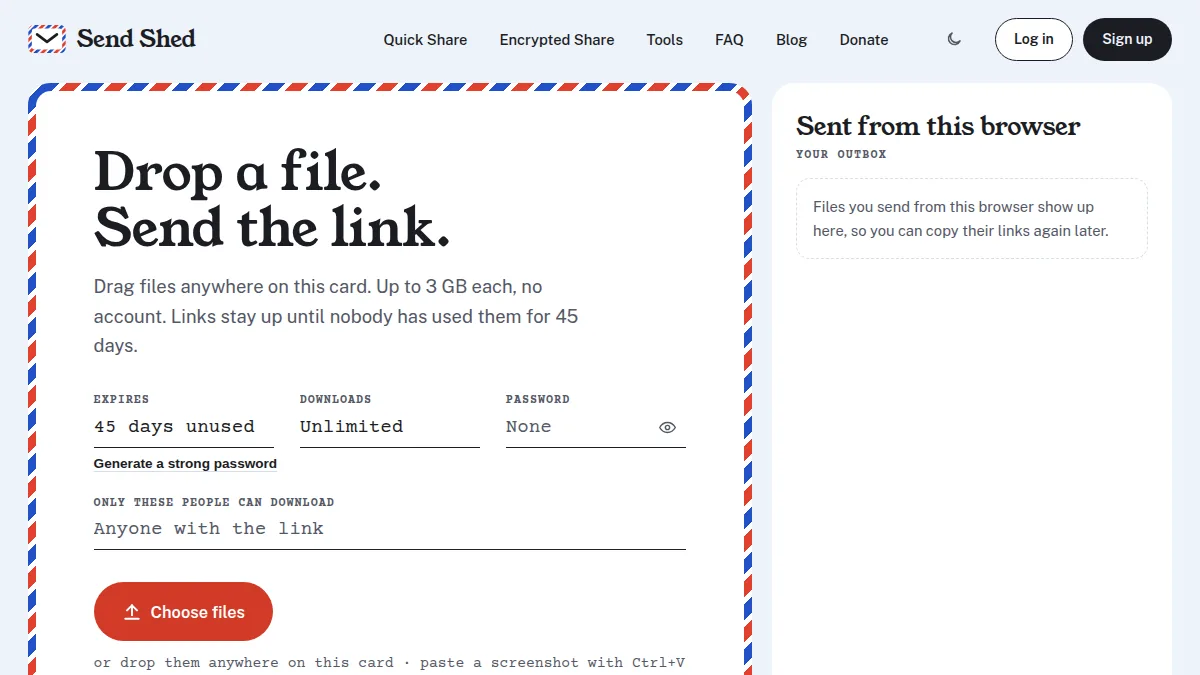
Send Shed's free, no-account Quick Share matches that per-file ceiling at 3 GB, but doesn't throttle how many times you use it — there's no monthly transfer count or cumulative byte cap. Send ten 3 GB files in a day and none of them count against each other. Links stay up while people keep using them, or you pick 1 hour, 24 hours or 7 days, instead of a fixed 3 days. If you regularly need to send larger files, a free Encrypted Share account raises the per-file limit to 5 GB with 10 GB of total storage, plus up to 30-day expiry.
The ads: WeTransfer's free download page isn't ad-free
WeTransfer monetizes free users with what it calls "Wallpaper" ads — full-page, high-resolution background images and video/rich-media placements that surround the upload and download screens. It's a deliberate, sold ad product (WeTransfer runs its own ad marketplace for it), not a stray banner. If you're sending or receiving something professional, that's a sponsor's ad on the same screen.
Send Shed doesn't run ads on any tier, free or paid. There's no ad product to opt out of because there isn't one.
The privacy question: what happened with WeTransfer's terms of service
In mid-2025, a wording change to WeTransfer's terms of service raised alarm because it could be read as granting WeTransfer broad rights to use uploaded content, including for improving machine-learning models. The backlash was immediate and widespread, and WeTransfer removed the disputed language shortly after, clarifying that files are not used to train AI. It's worth knowing about if privacy is why you're looking elsewhere, but it's also fair to say WeTransfer walked it back quickly once called out — this is a resolved incident, not an ongoing practice.
The more structural difference is that WeTransfer can technically access the contents of
anything you send — there's no end-to-end encryption on either its free or paid plans.
Send Shed's Encrypted Share tier encrypts your file (and its filename) in your browser with
AES-256-GCM before it ever leaves your device; the decryption key travels only in the link
itself, in the part after #, which browsers never send to a server. We can't
read an Encrypted Share file even if we wanted to. Quick Share, like WeTransfer, stores files
as uploaded (unencrypted) so they can be automatically screened for known CSAM before the
link goes live — a trade-off, not a hidden catch.
Where WeTransfer still has an edge
To be fair: WeTransfer's brand recognition means recipients rarely question a link from it, which is worth something if whoever you're sending to has never heard of Send Shed. The raw size numbers, though, are no longer the deciding factor — Quick Share's per-file ceiling now matches WeTransfer's 3 GB, without the ads, the fixed 3-day expiry, or WeTransfer's 10-transfers-or-3 GB-total monthly cap sitting on top of it.
More comparisons
- file.io alternative: same one-line upload, no ads
- Smash alternative: how Send Shed compares
- SwissTransfer alternative: when you need zero-knowledge encryption
- Google Drive link sharing alternative: send files with links that expire
- Firefox Send alternative: encrypted, expiring file sharing that still exists
- pixeldrain alternative: Send Shed vs. pixeldrain for private file sharing
- Is Pixeldrain private? What actually happens to your files
- x02.me alternative: what Send Shed adds for private, temporary file sharing
Try Send Shed instead
No account, no ads, no monthly transfer cap. Pick an expiry, add a password if you want one, and get a link.
Quick Share a file Create a free account