Is it safe to email tax documents, contracts, or photos?
Short answer: less safe than it feels, mostly for reasons that have nothing to do with your password strength. Email's actual weak points are structural, not personal.
Where the real risk actually is
Modern email is usually encrypted in transit (TLS) between mail servers, which stops someone eavesdropping on the wire, but that's not the same as end-to-end encryption. The message still sits, readable, on your provider's servers, the recipient's provider's servers, and both inboxes indefinitely -- and on any device either of you has ever synced that account to. A tax return you emailed three years ago is very likely still sitting in both your "Sent" folder and their inbox today, still fully readable, long after either of you needed it. Add in how easily an email gets forwarded, CC'd, or auto-archived somewhere neither of you controls, and the exposure window is really "indefinitely," not "until they download it."
None of that requires anyone's account to be hacked -- it's just what email is built to do: keep a permanent, easily-copyable record.
A narrower alternative: a link that actually goes away
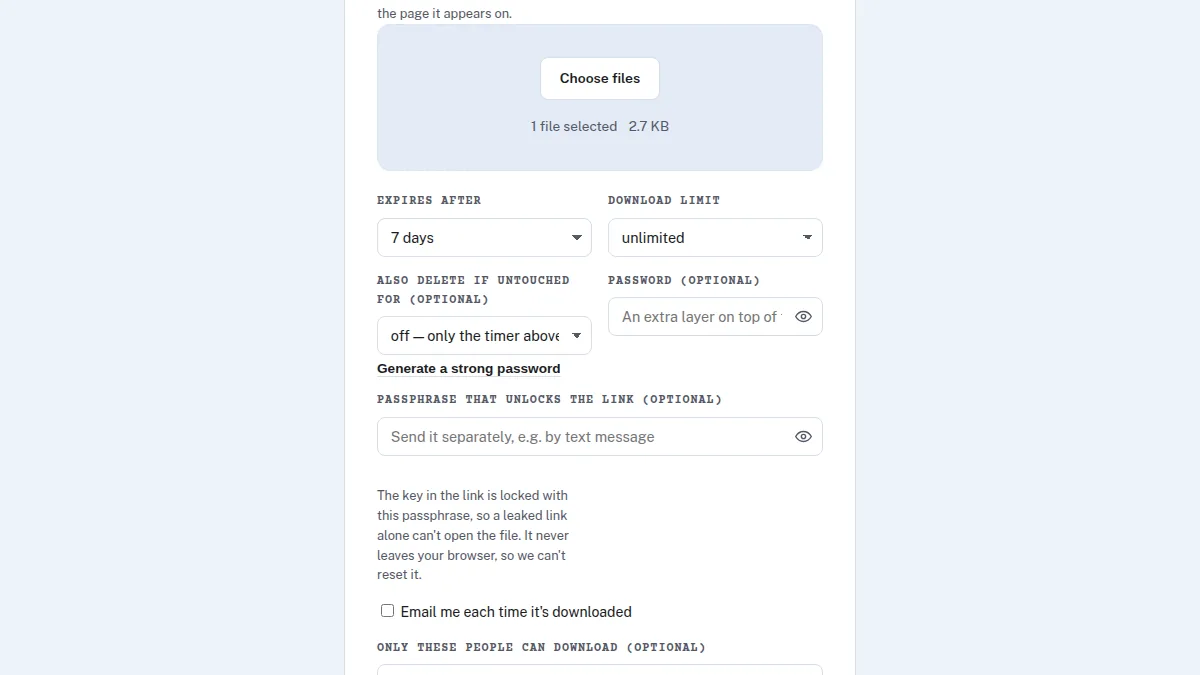
The fix isn't "don't use email" -- it's not attaching the sensitive file to the email at all. Send a link instead, and control what happens to it: Encrypted Share encrypts the file in your browser before upload with AES-256-GCM (the key never touches the server -- see our explainer on what zero-knowledge encryption actually means), lets you require a password before anyone can even see the file exists, and set an expiry so the link -- and the file behind it -- is actually gone after a day, a week, or a month, instead of living in an inbox forever. For something less sensitive but still awkward as an attachment, Quick Share covers the same "send a link instead" idea with no account needed.
Send the document, not a permanent copy of it
Encrypted, expiring, and gone when you say so.
Try Encrypted Share Quick Share instead